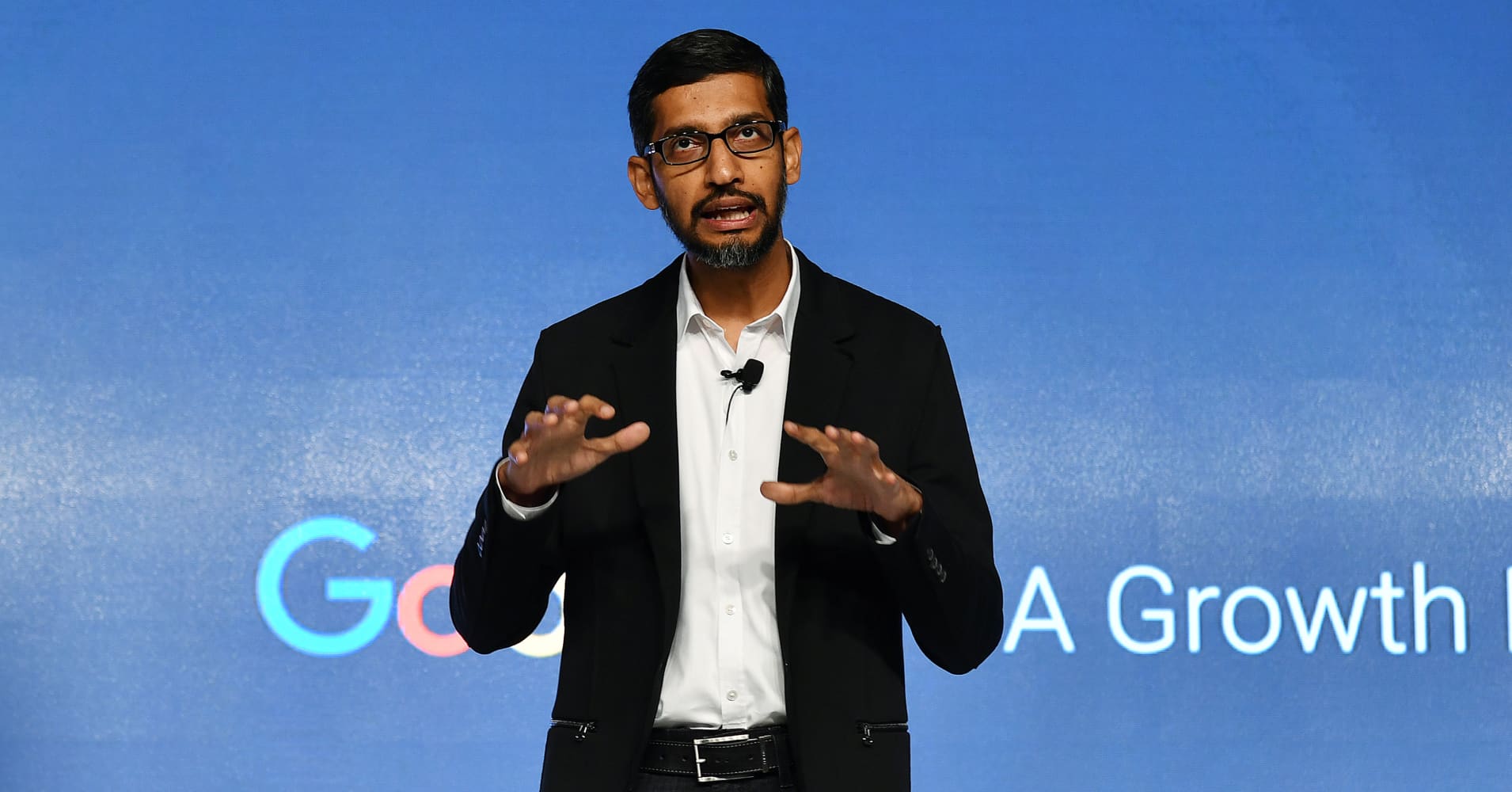
It's Sundar Pichai's turn in the Congressional hot seat.
Google's CEO will testify before the House Judiciary Committee on Tuesday where lawmakers will likely grill him on a wide range of issues, including potential political bias on its platforms, its plans for a censored search app in China, its privacy practices and more.
This will be the first time Pichai appears before Congress, since Google declined to send him or Alphabet CEO Larry Page to a hearing on foreign election meddling earlier this year. That slight sparked anger among senators who portrayed Google as trying to skirt scrutiny.
The hearing comes at the culmination of a tough year for big tech companies, as both lawmakers and the public have become increasingly skeptical about Silicon Valley's effects on democracy, misinformation and privacy. Tuesday's proceedings will test the soft-spoken executive's ability to remain cool and confident while defending Google in the face intense questioning.
Tuesday's hearing is titled "Transparency & Accountability: Examining Google and its Data Collection, Use, and Filtering Practices" and specifically focuses on the company's potential political bias and information filtering. Republican lawmakers — and even President Donald Trump himself — have previously accused Google and other tech platforms of suppressing conservative voices.
Although Google has denied accusations of bias and there is no proof that results on its search engine or YouTube are purposely skewed toward any particular ideology. Still, the inner workings of how exactly Google's platform's surface search results are both complicated and opaque and the company has faced bias complaints of other sorts.
Google is by far the most popular search engine in the world, with more than 90 percent market share, according to StatCounter, and regulators and competitors like Yelp have criticized Google for surfacing its own services, like maps, jobs postings, business reviews and travel information over information from other websites. Last year, the EU slapped Google with a $2.7 billion antitrust fine for its shopping results.
Google "has great influence over what millions of people can and cannot find on the Internet," House Majority Leader McCarthy (R-Ca.) said in a statement, which "comes with a responsibility to its users."
Overall, Google has faced multiple high-profile scandals over the course of 2018, and seen its workforce organize against it at a scale previously unheard of in the tech sector, particularly through a 20,000 person walkout in response to the company's handling of sexual misconduct.
In that vein, Pichai will likely face questions about Google decision earlier this year not to renew a Pentagon contract for analyzing drone videos using artificial intelligence. Google dropped that project, called Maven, following employee protest through petitions and resignations, and subsequently published an artificial intelligence ethics code that Google would work with the government and military on cybersecurity and training, but not on weapons or surveillance that violate "internationally accepted norms."
In his prepared remarks ahead of Tuesday's hearing, Pichai emphasized Google's patriotism, a stance that seemed aimed at appeasing critics who saw Google's abandonment of the so-called "Project Maven" as a turning its back on the Department of Defense.
"I am proud to say we do work, and we will continue to work, with the government to keep our country safe and secure," Pichai said in his prepared remarks.
Another topic sure to come up is Google's controversial plans to launch a censored search engine in China. The Intercept first reported details of the project, which would block search results for queries that the Chinese government deemed sensitive, like "human rights" and "student protest" and link users' searches to their personal phone numbers, earlier this summer.
This is another topic that has spurred Google employees to speak out publicly, with more than 730 recently signing an open letter calling on the company to cancel its efforts. Pichai has said that Google is "not close" to launching a censored search product in China, but has defended its experimentation by saying that its service could be a better option than current domestic products, and that it could serve most user queries. Meanwhile, human rights groups and lawmakers alike have criticized Google for potentially violating user privacy and aligning with China's oppressive regime.
Google's track record on privacy will likely come under fire, too, since it revealed Monday that a security bug allowed the profile information of 52.5 million Google Plus users to be viewable by developers, even if their profiles were set to private. This is the second Google Plus flaw of the year. In October, The Wall Street Journal reported that Google didn't disclose its first one for months because it feared regulatory scrutiny and damage to its reputation.
In his prepared remarks, Pichai said that Google supported federal privacy legislation, and he will likely be asked about it during Tuesday's hearing.
While Facebook's Congressional appearances earlier this year revealed that lawmakers' often possess only a scant understanding of how the technology they're questioning actually works, the way that Pichai responds will either help Google smooth over its Capitol Hill relations or create more headaches to come.
WATCH: Google's Larry Page has backed two flying-car start-ups — here's a look inside one of them

No comments:
Post a Comment