Pages

Monday, December 31, 2018

Merck surges more than 30% in 2018, taking the crown as biggest Dow winner

2018 may have been the worst year for the Dow Jones Industrial Average in a decade, but Merck managed to easily buck that trend.

Shares of the pharmaceutical giant are up more than 30 percent for the year, on pace for their biggest annual gain since 2006. Merck is also one of six Dow stocks to have posted a gain this quarter, rising more than 6 percent. Meanwhile, the Dow has fallen 6.7 percent in 2018 to mark its worst yearly performance since 2008.

A key driver for Merck's outperformance was the strong ramp-up in sales of Keytruda, a drug used to treat various forms of cancer. Keytruda sales surged 150 percent and 89 percent in the first and second quarter, respectively. Sales of the drug also climbed 80 percent during the third quarter on a year-over-year basis.

Vamil Divan, an analyst at Credit Suisse, said Merck and other pharmaceutical stocks also benefited from a "rotation" into defensive sectors like health care. "We expect some of that rotation to continue, but also see our companies needing to deliver innovation in order to overcome pricing pressures and drive further upside," Divan, who has Merck pegged as a top pick, wrote in a note to clients earlier this month.
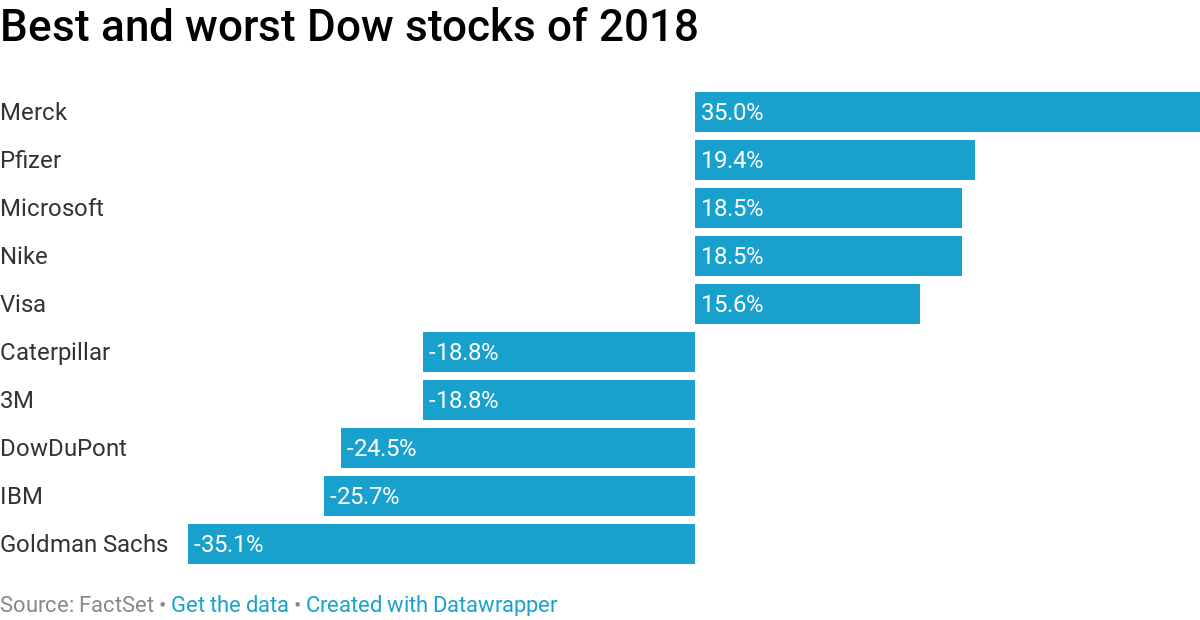
Shares Pfizer, one of Merck's biggest competitors, were the second-best Dow performers this year with a gain of more than 18 percent, also benefiting from the rotation into more defensive names. Merck has a dividend yield of 2.9 percent, while Pfizer has a 3.3 percent payout.

Microsoft, Nike and Visa rounded out the Dow's top five stocks as they all jumped at least 14 percent.

These strong yearly performances were outweighed by steep losses in Goldman Sachs, IBM, DowDuPont, Caterpillar and 3M, however.

Goldman Sachs was the worst-performing Dow stock of 2018, dropping about 36 percent. The stock has been under pressure this year as a scandal related to the defunct Malayan investment fund 1MDB lingers. Bank of America Merrill Lynch downgraded Goldman back in November, noting uncertainty over the scandal could fester.

IBM, meanwhile, struggled this year as it continued its transition away from enterprise technology as its main source of revenue. Caterpillar and 3M were pressured by an ongoing trade war between China and the U.S. as a large portion of their profits comes from overseas.

—CNBC's Michael Bloom contributed to this report.

Subscribe to CNBC on YouTube.

Let's block ads! (Why?)

from Top News & Analysis https://cnb.cx/2TieNGh
The winner for best trade of 2018 is... chocolate

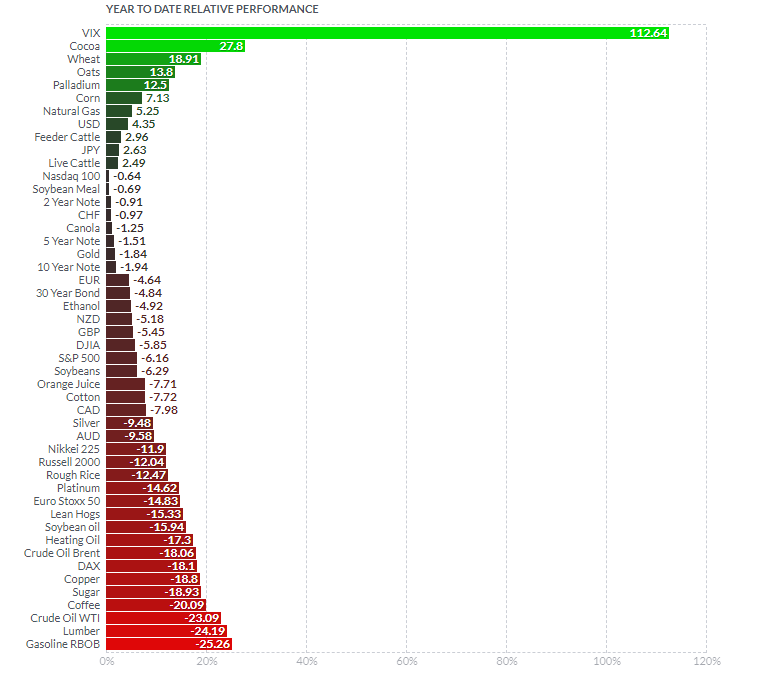
Looking back on a tumultuous year where the majority of asset classes were deep in the red, cocoa futures turned out to be one sweet spot.

In fact, a look at the top year-to-date performers among major futures markets reveals that cocoa has returned a whopping 28 percent this year. (This was lower only than complicated bets in volatility futures, which gain in value along with the CBOE Volatility Index. Volatility is not a pure asset class like a commodity or other security.)

Source: Finviz.com (Through Dec. 28)

While the stock market and other risk assets were battered this year on fears of slowing global growth and trade battles, cocoa prices enjoyed a surge because of short supply as the dry weather in top producing areas such as Ivory Coast hurt production.

"The main crop harvest is continuing in West Africa. Conditions are hot and dry. Main crop production ideas for Ivory Coast and Ghana are being reduced, with Ivory Coast now estimating its main crop production at 1.985 million tons, down from previous estimates just over 2.0 million tons," said Jack Scoville, senior softs analyst at Chicago's Price Futures Group, in a note on Friday.

"Conditions appear good in East Africa and Asia. Demand is said to be improving as offers from the new harvest start to increase," Scoville added.

The higher cost of cocoa, which is used to make chocolate, has put pressure on candy companies this year. The Hershey Company and Tootsie Roll Industries both lost about 6 percent in 2018, while Nestle is set to finish the year flat.

"We had some commodity and packaging headwind of about 20 basis points in the first half," François-Xavier Roger, Nestle's chief financial officer said in an earnings call in July. The company's "cost savings were partially offset by higher commodity and packaging costs ... In 2019 and 2020, I'm more encouraged by some of the internal projects we have underway to reduce our commodity costs."

Other than trading futures, investors could have also accessed the winning commodity through iPath Bloomberg Cocoa SubTR ETN, which gained 22 percent this year.

Let's block ads! (Why?)

from Top News & Analysis https://cnb.cx/2AqlQFZ